2026 Honda CR-V Review: Price, Hybrid MPG, TrailSport, Interior, Pros & Cons
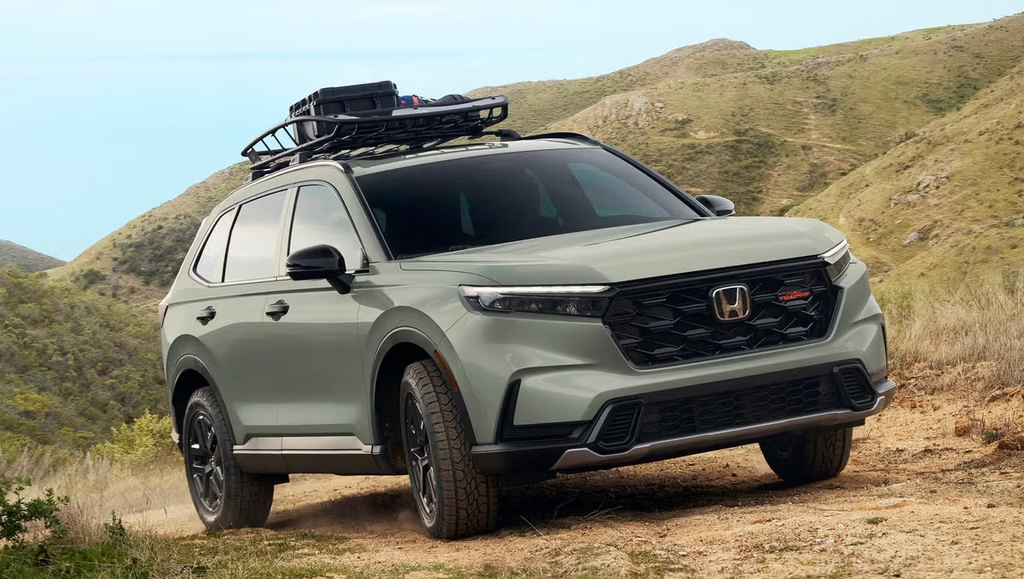
The Honda CR-V has become one of the most recognizable compact SUVs in the United States.
Its popularity comes from a fairly simple formula: comfortable seating, useful cargo space, strong fuel economy, available all-wheel drive, straightforward technology, and enough versatility to work as both a daily commuter and family vehicle.
For 2026, Honda continues to offer both a conventional 1.5-liter turbocharged engine and a more powerful two-motor hybrid system. The biggest addition to the lineup is the TrailSport Hybrid, which combines the 204-horsepower hybrid powertrain with standard all-wheel drive, all-terrain tires, and adventure-focused styling and equipment.
The 2026 CR-V starts at $30,920 MSRP, while the hybrid lineup begins at $35,630. At the top of the regular CR-V range, the Sport Touring Hybrid starts at $42,550.
In this 2026 Honda CR-V review, we examine pricing, trims, engine choices, hybrid performance, fuel economy, AWD capability, towing, cargo space, technology, safety equipment, TrailSport Hybrid features, pros and cons, and whether the CR-V is worth buying.
2026 Honda CR-V Overview
The CR-V is Honda’s mainstream compact crossover SUV.
It sits above the smaller HR-V and below larger SUVs such as the Passport and Pilot.
The 2026 lineup gives buyers seven primary trim choices:
- LX
- EX
- EX-L
- Sport Hybrid
- Sport-L Hybrid
- TrailSport Hybrid
- Sport Touring Hybrid
Honda separates the lineup into gasoline and hybrid models.
The LX, EX, and EX-L use a turbocharged gasoline engine.
Sport Hybrid, TrailSport Hybrid, Sport-L Hybrid, and Sport Touring Hybrid models use Honda’s two-motor hybrid powertrain.
Front-wheel drive is available on several trims, while Honda’s Real Time AWD system is optional on many versions.
AWD is standard on the TrailSport Hybrid and Sport Touring Hybrid.
This gives buyers considerable flexibility.
Someone living in a warmer climate can prioritize fuel economy with front-wheel drive, while drivers dealing with snow, rain, dirt roads, or changing weather can select AWD.
2026 Honda CR-V Price and Trims
Honda currently lists the 2026 CR-V starting at $30,920 MSRP, excluding the destination charge, taxes, registration, accessories, and dealer-related costs.
Honda CR-V LX — $30,920
The LX is the least expensive CR-V.
Despite being the entry-level version, it includes a 190-horsepower turbocharged engine, a 9-inch touchscreen, wireless phone charging, wireless smartphone connectivity, and available Real Time AWD.
For buyers who simply want CR-V practicality without premium trim pricing, the LX is worth considering.
Honda CR-V EX — $33,150
The EX adds several comfort and convenience features.
Honda lists equipment including:
- Heated front seats
- One-touch power moonroof
- Smart Entry
- Walk Away Auto Lock
- Dual-zone automatic climate control
- Power driver’s seat
- Blind Spot Information with Cross Traffic Monitor
The EX retains the 190-horsepower turbocharged engine and offers AWD as an option.
For many non-hybrid buyers, the EX may provide a strong balance between price and everyday comfort.
Honda CR-V EX-L — $35,400
The EX-L is the premium gasoline-powered CR-V.
It adds leather-trimmed seating, a power tailgate, parking sensors, and an automatic-dimming rearview mirror.
At this price, however, buyers should also compare it closely with the Sport Hybrid, because the hybrid starts only slightly higher.
Honda CR-V Sport Hybrid — $35,630
The Sport Hybrid is the least expensive hybrid CR-V.
Its two-motor hybrid system produces 204 horsepower.
Honda also gives it:
- 18-inch gloss-black alloy wheels
- Roof rails
- Sport exterior styling
- Heated front seats
- Sport Mode
- Wireless Apple CarPlay
- Wireless Android Auto
AWD is available.
For buyers focused on fuel economy, this may be one of the most attractive trims in the lineup.
Honda CR-V Sport-L Hybrid — $38,725
The Sport-L Hybrid builds on the Sport Hybrid with more premium interior equipment.
Features include:
- Leather-trimmed seating
- Heated front seats
- Power front seats
- Driver memory seat
- Power tailgate
- 10.2-inch digital instrument cluster
- Parking sensors
- 8-speaker audio system
AWD remains available rather than mandatory.
Honda CR-V TrailSport Hybrid — $38,800
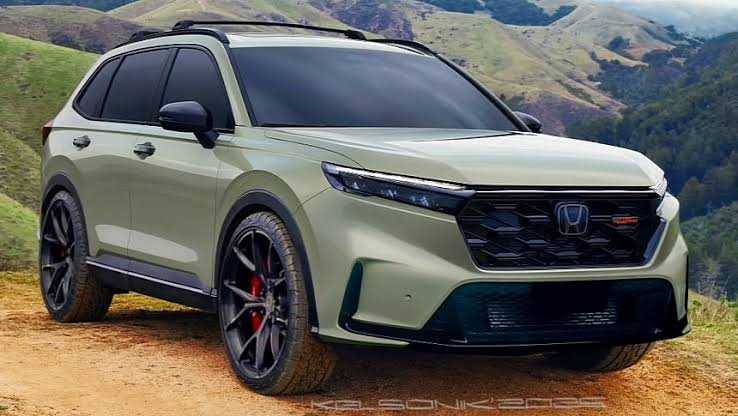
The TrailSport Hybrid is the major new addition for 2026.
It combines the 204-horsepower hybrid system with:
- Standard Real Time AWD
- 18-inch wheels
- All-terrain tires
- Roof rails
- TrailSport exterior styling
- All-season floor mats
- Heated steering wheel
- Power tailgate
- 10.2-inch digital instrument cluster
- Orange interior accents
The TrailSport is intended for buyers who want slightly more adventure capability without moving to a larger SUV such as the Honda Passport.
Honda CR-V Sport Touring Hybrid — $42,550
The Sport Touring Hybrid sits at the top of the regular CR-V range.
Its standard features include:
- 204-horsepower hybrid system
- Standard Real Time AWD
- 19-inch gloss-black alloy wheels
- Leather seating
- Bose premium audio
- Hands-free power tailgate
- Google built-in
- Heated steering wheel
- 10.2-inch digital instrument cluster
This is the CR-V for buyers who want hybrid efficiency combined with the lineup’s highest level of technology and comfort.
1.5-Liter Turbocharged Engine
The LX, EX, and EX-L use Honda’s 1.5-liter turbocharged four-cylinder gasoline engine.
Honda rates it at:
190 horsepower
179 lb-ft of torque
The engine’s peak torque is available from approximately 1,700 to 5,000 rpm.
It is paired with a continuously variable transmission, commonly called a CVT.
For normal commuting and family use, 190 horsepower should be sufficient.
The turbo engine also has one advantage over the hybrid models for buyers planning to tow: it carries the CR-V’s higher 1,500-pound towing rating.
2026 Honda CR-V Hybrid Powertrain
Hybrid CR-V models use Honda’s two-motor hybrid system.
The powertrain produces:
204 horsepower
Honda describes it as providing both stronger acceleration and excellent efficiency, with Sport Mode available on hybrid trims.
Rather than operating like a traditional automatic transmission, Honda’s hybrid system can switch among different methods of using the engine and electric motors.
Depending on conditions, the vehicle can operate using electric propulsion, hybrid operation, or direct engine drive.
This allows the system to prioritize efficiency without requiring the driver to constantly manage different settings.
For city driving, where regenerative braking and electric assistance are especially useful, the hybrid makes a lot of sense.
2026 Honda CR-V MPG
Fuel economy is one of the CR-V’s strongest advantages.
Gasoline CR-V MPG
Front-wheel-drive versions of the turbocharged CR-V receive EPA ratings of approximately:
28 mpg city
33 mpg highway
30 mpg combined
AWD versions are rated at approximately:
27 mpg city
31 mpg highway
29 mpg combined
Those are respectable figures for a gasoline compact SUV.
CR-V Hybrid MPG
Front-wheel-drive Sport Hybrid and Sport-L Hybrid models achieve significantly better city fuel economy.
Honda lists EPA ratings of:
43 mpg city
36 mpg highway
40 mpg combined
AWD hybrid versions are rated at approximately:
40 mpg city
34 mpg highway
37 mpg combined
That 43-mpg city rating makes the front-wheel-drive hybrid particularly attractive for urban commuters.
Hybrid systems are often most efficient in city driving because they can recover energy during braking and rely more heavily on electric assistance at lower speeds.
TrailSport Hybrid MPG
The TrailSport Hybrid sacrifices some fuel economy because it includes standard AWD and all-terrain tires.
Honda rates it at approximately:
38 mpg city
33 mpg highway
35 mpg combined
Those figures are still impressive for an AWD SUV equipped with all-terrain tires.
The tradeoff is straightforward: the regular hybrid provides better efficiency, while TrailSport adds equipment intended for rougher roads and outdoor use.
Honda Real Time AWD
Honda’s Real Time AWD system is available across much of the CR-V range.
The system can send additional power to the rear wheels when extra traction is required.
Honda specifically notes that it can transfer additional power rearward when conditions such as steering input indicate that additional traction may be useful.
AWD can be beneficial for:
- Snow
- Heavy rain
- Gravel roads
- Dirt roads
- Steep driveways
- Slippery surfaces
It does not transform the CR-V into a heavy-duty off-road vehicle.
But for most American drivers dealing with changing weather and occasional unpaved roads, it provides useful additional capability.
2026 Honda CR-V TrailSport Hybrid
The TrailSport Hybrid deserves special attention because it is the most important new CR-V variant for 2026.
Honda combines its 204-horsepower hybrid system with standard Real Time AWD and all-terrain tires.
Additional features include:
- 18-inch alloy wheels
- Roof rails
- TrailSport styling
- Power tailgate
- Heated front seats
- Heated steering wheel
- All-season floor mats
- Orange ambient lighting
- 10.2-inch digital instrument cluster
- Wireless smartphone connectivity
Honda also promotes compatibility with its Trail Experience app, which can provide vehicle and terrain information through Apple CarPlay.
The TrailSport has approximately 8.2 inches of ground clearance, matching other AWD CR-V configurations.
That means buyers should keep expectations realistic.
The TrailSport Hybrid is not a rock-crawling SUV.
Instead, it is designed to provide a little more confidence for camping, gravel routes, dirt roads, snowy conditions, trailheads, and outdoor recreation.
2026 Honda CR-V Towing Capacity
The CR-V can tow, but towing is not one of its primary strengths.
Gasoline-powered LX, EX, and EX-L models are rated to tow up to:
1,500 pounds
Hybrid versions are rated to tow up to:
1,000 pounds
A 1,500-pound rating may be useful for:
- Small utility trailers
- Lightweight personal watercraft
- Small cargo trailers
- Certain lightweight recreational equipment
The hybrid’s 1,000-pound rating is more restrictive.
Honda’s owner information also emphasizes that total trailer weight includes the trailer itself plus everything carried inside or on it.
Anyone planning serious towing should consider a larger vehicle.
The Honda Passport, Pilot, Ridgeline, or a full-size pickup will be much better suited to heavy trailers.
CR-V Cargo Space
Interior practicality is one of the strongest reasons to buy a CR-V.
Honda advertises up to 76.5 cubic feet of cargo space with the second row folded.
The second-row seatback uses a 60/40 split and can recline or fold.
That gives owners flexibility when carrying a combination of passengers and larger items.
The cargo area can handle everyday loads such as:
- Groceries
- Baby strollers
- Suitcases
- Camping equipment
- Sports gear
- Boxes
- Small furniture
- Pet equipment
For families that do not need a third row, this is one of the CR-V’s biggest advantages.
Passenger Space
The CR-V seats five people.
Honda’s official specifications list approximately 41 inches of second-row legroom, providing adult-friendly rear seating.
That matters because some compact crossovers technically seat five but provide cramped rear seating for adults.
The CR-V is designed to function as a genuine family vehicle rather than simply a lifted small car.
Parents can install child seats in the rear without sacrificing all front-seat space, while adults can use the second row comfortably on longer journeys.
2026 Honda CR-V Interior
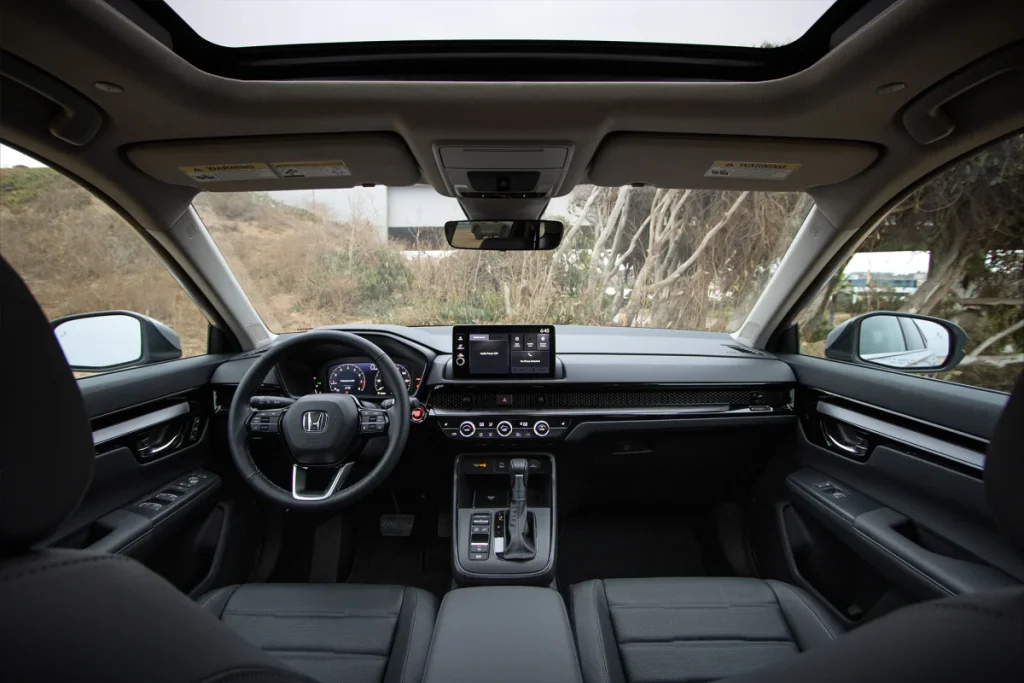
The CR-V’s interior focuses more on functionality than flashy design.
The dashboard layout is relatively clean, physical controls remain available for important functions, and storage areas are positioned throughout the cabin.
Depending on trim, available interior features include:
- Cloth or leather-trimmed seating
- Heated front seats
- Heated steering wheel
- Power front seats
- Driver memory
- Dual-zone climate control
- Power moonroof
- Power tailgate
- Hands-free power tailgate
- Bose premium audio
Higher hybrid trims feel considerably more premium than the basic LX.
For buyers who want luxury-level materials, however, premium-brand compact SUVs will still provide a more upscale environment.
9-Inch Touchscreen
For 2026, Honda equips the CR-V with a 9-inch color touchscreen across the lineup.
Wireless Apple CarPlay and Android Auto compatibility make it easy to use common smartphone functions without connecting a cable.
Depending on trim, technology can include:
- Wireless Apple CarPlay
- Wireless Android Auto
- Wireless phone charger
- Bluetooth streaming
- Front and rear USB ports
- Digital instrument display
- Google built-in
- Bose premium sound system
The 9-inch display is not enormous by modern SUV standards, but it should be large enough for normal navigation, music, phone, and vehicle functions.
Google Built-in
Google built-in is available on the Sport Touring Hybrid.
This brings integrated access to services such as:
- Google Maps
- Google Assistant
- Google Play-supported applications
Integrated navigation can be useful when a driver does not want to rely entirely on smartphone projection.
However, wireless Apple CarPlay and Android Auto are already available, so many buyers may simply continue using their preferred phone-based ecosystem.
Honda Sensing Safety Technology
The 2026 CR-V includes Honda Sensing driver-assistance technology across the lineup.
Available or standard systems depending on trim include:
- Collision Mitigation Braking System
- Road Departure Mitigation
- Forward Collision Warning
- Lane Departure Warning
- Adaptive Cruise Control with Low-Speed Follow
- Lane Keeping Assist
- Traffic Sign Recognition
- Blind Spot Information
- Cross Traffic Monitor
Adaptive Cruise Control with Low-Speed Follow can adjust vehicle speed based on traffic ahead and can bring the CR-V to a stop when the detected vehicle ahead stops.
These technologies can reduce driver workload, particularly during long highway trips.
They should not be treated as autonomous-driving systems.
The driver remains responsible for monitoring traffic and controlling the vehicle.
CR-V as a Daily Commuter
The CR-V is particularly well suited to commuting.
Its compact exterior dimensions make it easier to drive and park than a large three-row SUV, while the interior still provides enough room for passengers and cargo.
The hybrid is especially attractive for city commuters.
A front-wheel-drive hybrid rated at 43 mpg city can substantially reduce fuel consumption compared with many traditional SUVs.
Drivers who travel long highway distances may find the difference between the gas and hybrid versions less dramatic because highway fuel-economy ratings are closer.
Anyone considering the hybrid should therefore look at their actual driving pattern rather than assuming it will always produce enormous fuel savings.
CR-V as a Family SUV
The CR-V’s five-seat configuration works particularly well for small and medium-size families.
Useful family-oriented characteristics include:
- Spacious rear seat
- Up to 76.5 cu. ft. cargo capacity
- Rear USB ports
- Available power tailgate
- Easy cargo access
- Honda Sensing
- Available AWD
- Good fuel economy
- 60/40 folding rear seats
Families requiring six, seven, or eight seats should look at a Honda Pilot or another three-row SUV.
For a family that only needs five seats, however, purchasing a larger SUV can mean spending more money on the vehicle and fuel without gaining much everyday benefit.
CR-V for Winter Driving
Drivers living in snowy regions should consider Real Time AWD.
Honda equips the TrailSport Hybrid and Sport Touring Hybrid with AWD as standard and offers it on other trims.
Snow Mode can also adjust vehicle behavior to help drivers accelerate and decelerate more smoothly on slippery roads.
However, tires remain extremely important.
An AWD SUV on inappropriate tires can still struggle in severe winter conditions.
Buyers dealing with significant snow should consider suitable winter tires regardless of whether the vehicle has AWD.
2026 Honda CR-V Pros
Excellent Hybrid Fuel Economy
Front-wheel-drive hybrid versions achieve EPA ratings of up to 43 mpg city and 40 mpg combined.
That is one of the CR-V’s biggest strengths.
Useful Interior Space
Up to 76.5 cubic feet of cargo capacity gives the CR-V excellent practicality for its size.
Two Powertrain Choices
Unlike the 2026 Toyota RAV4, which has moved to an electrified-only U.S. lineup, the CR-V still lets buyers choose between a traditional turbocharged engine and a hybrid.
204-Horsepower Hybrid
The hybrid provides more power than the regular 190-horsepower turbo engine while also offering excellent city fuel economy.
Available AWD
Real Time AWD is available across most trims and standard on TrailSport Hybrid and Sport Touring Hybrid.
New TrailSport Hybrid
The TrailSport adds all-terrain tires, standard AWD, useful outdoor equipment, and distinctive styling without forcing buyers into a much larger SUV.
Standard 9-Inch Touchscreen
Even the LX receives a modern 9-inch display and wireless smartphone connectivity.
Strong Safety Package
Honda Sensing includes several important driver-assistance systems across the lineup.
Spacious Rear Seat
Approximately 41 inches of rear legroom helps the CR-V work well for families and adult passengers.
2026 Honda CR-V Cons
Hybrid Towing Capacity Is Limited
Hybrid versions are rated at only 1,000 pounds of towing capacity.
Anyone planning to tow regularly may need something larger.
Gasoline Engine Is Less Efficient
The 1.5-liter turbo is reasonably economical, but it cannot match the hybrid’s city MPG.
Top Trims Become Expensive
The Sport Touring Hybrid starts at $42,550 before destination, taxes, options, and dealer costs.
At that price, buyers have many other SUV choices.
No Plug-in Hybrid Option
The regular 2026 CR-V lineup does not offer a conventional plug-in hybrid comparable with the 2026 Toyota RAV4 PHEV.
Honda separately offers the limited-market CR-V e:FCEV hydrogen plug-in model, but that is a highly specialized vehicle available only in limited circumstances, rather than a mainstream nationwide PHEV.
TrailSport Is Not a Hardcore Off-Roader
All-terrain tires and standard AWD are useful, but the CR-V remains fundamentally a compact crossover.
No Third Row
The CR-V seats five.
Larger families will need another vehicle.
Who Should Consider the 2026 Honda CR-V?
The CR-V is particularly well suited to:
- Small families
- Daily commuters
- Hybrid buyers
- Drivers wanting high city MPG
- People needing a spacious cargo area
- Buyers wanting available AWD
- Drivers living in snowy or rainy climates
- Outdoor-oriented buyers considering TrailSport
- Buyers wanting a comfortable five-seat SUV
- People who do not need heavy towing
- Drivers who want straightforward technology
For mainstream buyers, the Sport Hybrid deserves especially serious consideration.
It provides the 204-horsepower hybrid system without forcing customers into the considerably higher price of the Sport Touring.
2026 Honda CR-V vs. Toyota RAV4
The Toyota RAV4 is arguably the CR-V’s biggest rival.
For 2026, the two vehicles take somewhat different approaches.
Toyota has moved the RAV4 lineup entirely to hybrid and plug-in hybrid powertrains.
Honda continues to give CR-V customers the choice between a 190-horsepower turbo engine and a 204-horsepower hybrid.
The CR-V offers excellent passenger and cargo space and up to 43 mpg city in FWD hybrid form.
The redesigned 2026 RAV4 counters with more powerful hybrid options, an available plug-in hybrid, and greater towing capability on selected configurations.
The better vehicle therefore depends heavily on what the buyer values.
Someone prioritizing comfortable interior packaging and straightforward hybrid efficiency may prefer the CR-V.
A buyer wanting plug-in electric driving or more towing capacity may find the RAV4 more attractive.
CR-V vs. Other Compact SUVs
The CR-V competes in one of the most crowded vehicle segments in America.
Alternatives include:
- Toyota RAV4
- Hyundai Tucson
- Kia Sportage
- Subaru Forester
- Mazda CX-5
- Mazda CX-50
- Nissan Rogue
- Chevrolet Equinox
- Ford Escape
Each competitor emphasizes different strengths.
Mazda models may appeal more to driving enthusiasts.
The Subaru Forester emphasizes standard AWD and outdoor usability.
Hyundai and Kia offer strong technology and long equipment lists.
The RAV4 provides a broad electrified lineup.
The CR-V’s strength is how well it balances several priorities at once.
It does not have to be the most powerful, cheapest, or most extreme SUV to make sense for a large number of buyers.
Is the 2026 Honda CR-V Worth Buying?
For buyers searching for a practical five-passenger compact SUV, the 2026 Honda CR-V remains one of the strongest vehicles to compare.
Its biggest advantages are fuel economy, passenger room, cargo space, hybrid availability, AWD options, straightforward technology, and everyday usability.
The hybrid models are particularly compelling.
A Sport Hybrid starts at $35,630 and produces 204 horsepower while achieving as much as 43 mpg city in front-wheel-drive form.
The new TrailSport Hybrid adds a different personality to the lineup by combining the hybrid system with standard AWD, all-terrain tires, roof rails, and adventure-oriented equipment.
The biggest weaknesses are relatively modest towing capacity and the lack of a mainstream plug-in hybrid model.
Still, most compact-SUV buyers do not purchase their vehicles primarily for towing.
For commuting, family transportation, grocery runs, road trips, and general everyday use, the CR-V checks a lot of boxes without becoming unnecessarily large or complicated.
For value-focused buyers, the EX or Sport Hybrid may be the strongest choices.
For customers wanting leather and additional comfort, EX-L and Sport-L Hybrid make sense.
Outdoor-oriented buyers should look at the TrailSport Hybrid.
And buyers wanting nearly every available comfort and technology feature can choose the Sport Touring Hybrid.
Before purchasing, compare actual dealer pricing, insurance costs, financing offers, AWD requirements, annual mileage, and competing SUVs.
Frequently Asked Questions
How Much Does the 2026 Honda CR-V Cost?
The 2026 Honda CR-V LX currently starts at $30,920 MSRP before destination and other charges.
How Much Does the 2026 CR-V Hybrid Cost?
The Sport Hybrid starts at $35,630 MSRP.
How Much Horsepower Does the 2026 CR-V Have?
Gasoline versions produce 190 horsepower, while hybrid versions produce 204 horsepower.
What MPG Does the 2026 Honda CR-V Hybrid Get?
Front-wheel-drive hybrid versions are rated at approximately 43 mpg city, 36 highway, and 40 combined.
AWD hybrid versions are rated around 40 city, 34 highway, and 37 combined.
What MPG Does the Gas CR-V Get?
Front-wheel-drive gasoline versions are rated at approximately 28 city, 33 highway, and 30 combined.
Does the 2026 Honda CR-V Have AWD?
Yes.
Honda’s Real Time AWD is available on most trims and standard on TrailSport Hybrid and Sport Touring Hybrid.
How Much Can the CR-V Tow?
Gasoline CR-V models can tow up to approximately 1,500 pounds.
Hybrid versions are rated for up to approximately 1,000 pounds.
How Much Cargo Space Does the CR-V Have?
Honda advertises up to 76.5 cubic feet of cargo capacity with the rear seating folded.
What Is the 2026 CR-V TrailSport Hybrid?
The TrailSport Hybrid is an adventure-oriented CR-V using the 204-horsepower hybrid system, standard AWD, 18-inch wheels, all-terrain tires, roof rails, and TrailSport-specific styling and equipment.
Is the TrailSport Hybrid Good for Off-Road Driving?
It is better suited to dirt roads, trails, snow, campsites, and light outdoor use than a normal CR-V, but it is not designed to replace a dedicated off-road SUV.
Does the 2026 CR-V Have Apple CarPlay?
Yes.
Wireless Apple CarPlay and wireless Android Auto compatibility are available across the 2026 lineup through the 9-inch touchscreen.
Which 2026 CR-V Is Best for Fuel Economy?
The front-wheel-drive Sport Hybrid and Sport-L Hybrid provide the highest official fuel-economy ratings at approximately 43 mpg city and 40 mpg combined.
Which CR-V Is Best for Outdoor Use?
The TrailSport Hybrid is the obvious choice because it includes standard AWD and all-terrain tires.
Which CR-V Is Best Overall?
For many buyers, the Sport Hybrid provides one of the best combinations of price, power, fuel economy, equipment, and practicality.
Final Verdict
The 2026 Honda CR-V remains an excellent all-around compact SUV for American buyers.
Its appeal is not based on one outrageous specification.
Instead, it succeeds by combining several useful qualities in one vehicle: comfortable five-passenger seating, excellent cargo capacity, efficient engines, available AWD, modern safety equipment, wireless smartphone connectivity, and an attractive hybrid option.
The standard turbocharged CR-V remains useful for buyers who want the lower purchase price or higher 1,500-pound towing rating.
But for many customers, the 204-horsepower Sport Hybrid is probably the sweet spot.
It delivers up to 43 mpg city while retaining the passenger space and practicality that make the CR-V so useful.
The new TrailSport Hybrid also makes the lineup more interesting for outdoor-oriented buyers, although shoppers should understand that it remains a compact crossover rather than a serious off-road truck.
If your priorities are fuel economy, family practicality, cargo space, comfort, and easy everyday driving, the 2026 Honda CR-V deserves a place near the top of your shopping list.
Disclaimer: Vehicle prices, specifications, fuel-economy ratings, towing capacity, equipment, and availability can vary by trim and configuration and may change during the model year. Always verify current specifications and pricing with Honda and the specific vehicle documentation before purchasing or towing.