2026 Toyota Camry Review: Price, MPG, Hybrid Specs, AWD, Pros & Cons
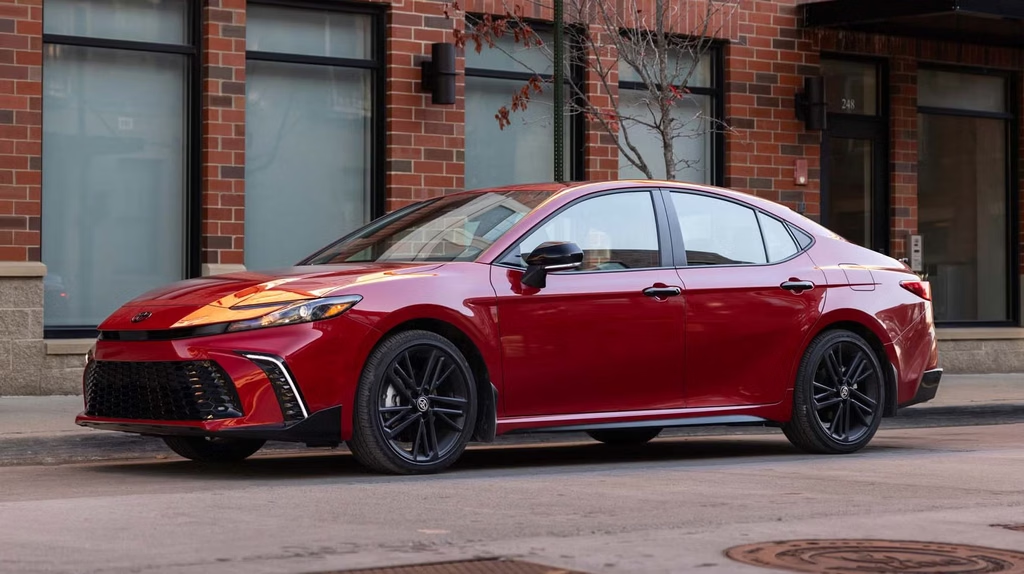
The Toyota Camry has been one of the most recognizable midsize sedans in America for decades.
While many manufacturers have reduced their sedan lineups in favor of SUVs and crossovers, Toyota continues to invest heavily in the Camry. The latest generation combines the familiar practicality of a four-door family sedan with a standard hybrid powertrain, modern safety technology, available all-wheel drive, and fuel economy that can exceed 50 mpg in certain configurations.
For 2026, the Camry remains exclusively hybrid and adds a new Nightshade Edition with black exterior details and 19-inch wheels. Toyota also introduces a new Dark Cosmos exterior color on selected trims.
The current U.S. lineup includes LE, SE, Nightshade, XLE, and XSE grades, with both front-wheel-drive and all-wheel-drive versions available for every trim.
In this 2026 Toyota Camry review, we examine its price, hybrid system, horsepower, fuel economy, AWD capability, trims, Nightshade Edition, interior, cargo space, technology, safety equipment, advantages, disadvantages, and whether it remains one of the best sedan choices for American buyers.
2026 Toyota Camry Overview
The Camry is Toyota’s mainstream midsize sedan.
It sits above the smaller Corolla and provides five-passenger seating, a larger cabin, more rear-seat space, and a more comfortable highway-driving experience.
The biggest mechanical change introduced with the ninth-generation Camry continues for 2026: there is no traditional gasoline-only version.
Every 2026 Camry uses Toyota’s fifth-generation hybrid system together with a 2.5-liter four-cylinder gasoline engine.
Front-wheel-drive models produce 225 net combined horsepower.
All-wheel-drive models increase output to 232 net combined horsepower because an additional electric motor helps power the rear wheels.
The five primary 2026 trims are:
- LE
- SE
- Nightshade
- XLE
- XSE
Every trim can be purchased with either front-wheel drive or electronic on-demand all-wheel drive.
That gives the Camry an unusual advantage among efficient family sedans because customers living in colder parts of the United States do not need to move to an SUV simply to get AWD.
2026 Toyota Camry Price
Toyota’s current U.S. regional listings show the 2026 Camry LE starting at approximately $29,600 MSRP before destination charges, taxes, registration, dealer fees, accessories, and options.
Prices increase depending on trim and drivetrain.
Toyota Camry LE — $29,600
The LE is the least expensive Camry.
Despite being the entry-level model, it still comes with the same basic fifth-generation Toyota Hybrid System used throughout the lineup.
Toyota currently lists the LE at approximately:
$29,600 MSRP
It also provides the best fuel economy in the Camry range.
Front-wheel-drive LE models are currently rated at approximately:
52 mpg city
49 mpg highway
For buyers focused primarily on value and fuel costs, the LE is arguably the most logical Camry.
Toyota Camry LE AWD — $31,125
Adding electronic all-wheel drive increases the current starting MSRP to around:
$31,125
The AWD LE remains extremely fuel-efficient, with Toyota listing approximately:
50 mpg city
49 mpg highway
That combination of AWD and near-50-mpg efficiency is particularly attractive for commuters living in snowy areas.
Toyota Camry SE — $32,100
The SE gives the Camry a more aggressive personality.
Toyota currently lists it starting at approximately:
$32,100
The SE receives sport-oriented exterior styling and a firmer suspension setup designed to provide more responsive handling.
Toyota specifically tunes the SE, Nightshade, and XSE with sport-oriented suspension components.
The FWD SE is rated at approximately:
47 mpg city
45 mpg highway
Toyota Camry SE AWD — $33,625
The AWD version currently starts around:
$33,625
Toyota lists approximately:
46 mpg city
46 mpg highway
It provides additional traction without the significant fuel-economy penalty traditionally associated with AWD systems.
Toyota Camry Nightshade — $33,100
The Nightshade is the major new addition for 2026.
Toyota currently lists the FWD Nightshade starting at approximately:
$33,100
It uses the SE as its foundation but adds distinctive blacked-out styling.
Fuel economy is approximately:
47 mpg city
45 mpg highway
Toyota Camry Nightshade AWD — $34,625
The AWD Nightshade currently starts at approximately:
$34,625
Toyota lists fuel economy of approximately:
46 mpg city
46 mpg highway.
Toyota Camry XLE — $34,800
The XLE focuses more heavily on comfort and refinement.
Toyota currently lists the front-wheel-drive XLE at approximately:
$34,800
It receives premium interior appointments and can be equipped with several advanced technology features unavailable on lower trims.
Toyota Camry XLE AWD — $36,325
Adding all-wheel drive brings the current starting MSRP to around:
$36,325.
Toyota Camry XSE — $36,000
The XSE combines premium equipment with the Camry’s sportier exterior styling and suspension.
Toyota currently lists the FWD XSE at approximately:
$36,000
This trim is aimed at buyers who want the most aggressive-looking version without sacrificing the Camry’s everyday practicality.
Toyota Camry XSE AWD — $37,525
The AWD XSE currently starts around:
$37,525
Toyota lists approximately:
43 mpg city
43 mpg highway for this configuration.
The XSE AWD therefore trades some efficiency for additional equipment, larger wheels, sportier styling, and all-weather traction.
2026 Toyota Camry Hybrid Engine
Every 2026 Camry uses Toyota’s fifth-generation hybrid system.
The system combines:
- A 2.5-liter four-cylinder gasoline engine
- Electric motor-generators
- Lithium-ion hybrid battery
- Electronically controlled continuously variable transmission
Front-wheel-drive models produce:
225 net combined horsepower
AWD models produce:
232 net combined horsepower.
Toyota says engineers tuned the latest hybrid system to provide more natural acceleration by increasing electric-motor assistance and reducing unnecessary engine-speed increases during acceleration.
That matters because older hybrid vehicles were sometimes criticized for producing a noticeable increase in engine noise without a corresponding feeling of acceleration.
The newer system is intended to feel more conventional while retaining excellent fuel economy.
How the Camry Hybrid System Works
The Camry is a regular hybrid rather than a plug-in hybrid.
That means owners do not need to plug the vehicle into a charger.
The hybrid battery is charged automatically through normal vehicle operation and regenerative braking.
During driving, the system can combine gasoline and electric power depending on conditions.
At lower speeds and under light loads, electric assistance can reduce gasoline consumption.
During stronger acceleration, the gasoline engine and electric motor can work together.
When slowing down, regenerative braking converts some of the vehicle’s kinetic energy back into electrical energy that can be stored in the hybrid battery.
For many owners, the biggest advantage is simple: you get hybrid fuel economy without needing to change your normal fueling routine.
2026 Toyota Camry MPG
Fuel economy is one of the strongest reasons to consider a Camry.
The exact EPA estimate changes significantly depending on trim, wheels, and drivetrain.
Toyota’s current U.S. listings show the most efficient 2026 Camry LE achieving approximately:
52 mpg city
49 mpg highway
The LE AWD remains remarkably efficient at approximately:
50 mpg city
49 mpg highway.
Other current estimates include:
- SE FWD — 47 city / 45 highway
- SE AWD — 46 city / 46 highway
- Nightshade FWD — 47 city / 45 highway
- Nightshade AWD — 46 city / 46 highway
- XLE FWD — 47 city / 45 highway
- XLE AWD — 46 city / 46 highway
- XSE FWD — 47 city / 45 highway
- XSE AWD — 43 city / 43 highway
The LE is therefore the obvious choice for someone prioritizing fuel costs.
Larger wheels, sportier tires, AWD hardware, and additional equipment generally reduce efficiency slightly.
How Much Fuel Can a Camry Hybrid Save?
Actual savings depend on how much someone drives and what vehicle they are replacing.
A commuter covering thousands of miles each year can potentially benefit significantly from a sedan capable of returning around 50 mpg.
Hybrid efficiency is especially useful in city traffic because regenerative braking and electric assistance work frequently during stop-and-go driving.
Someone replacing a truck or large SUV could see a very large reduction in fuel use.
The savings compared with another efficient compact hybrid, however, would obviously be smaller.
Drivers should therefore compare annual fuel consumption rather than focusing only on the headline MPG figure.
2026 Toyota Camry AWD
Toyota’s Electronic On-Demand All-Wheel Drive system is available on every Camry trim.
Unlike a traditional mechanical AWD system with a driveshaft permanently connecting the engine to the rear axle, the hybrid Camry uses an additional electric motor to provide power to the rear wheels when necessary.
Toyota says the system can add traction during conditions such as poor weather and cornering.
AWD can be useful in:
- Snow
- Heavy rain
- Slippery roads
- Steep driveways
- Changing winter conditions
The system does not transform the Camry into an off-road vehicle.
Ground clearance remains sedan-like, and the Camry is intended primarily for paved-road driving.
But for someone who prefers a sedan and lives in Colorado, New York, Michigan, Pennsylvania, or another snowy region, AWD makes the Camry much easier to consider.
Front-Wheel Drive vs. AWD
Choosing between FWD and AWD depends mainly on climate and driving conditions.
Front-wheel drive offers:
- Lower purchase price
- Slightly better fuel economy
- Less mechanical complexity
- More than enough traction for many climates
AWD offers:
- Additional traction
- More confidence during winter weather
- Better power distribution on slippery surfaces
- 232 hp instead of 225 hp
Someone living in Florida, Southern California, Arizona, or another mild climate may get little practical value from paying for AWD.
A buyer regularly dealing with snow and ice may find the additional cost worthwhile.
New 2026 Camry Nightshade Edition
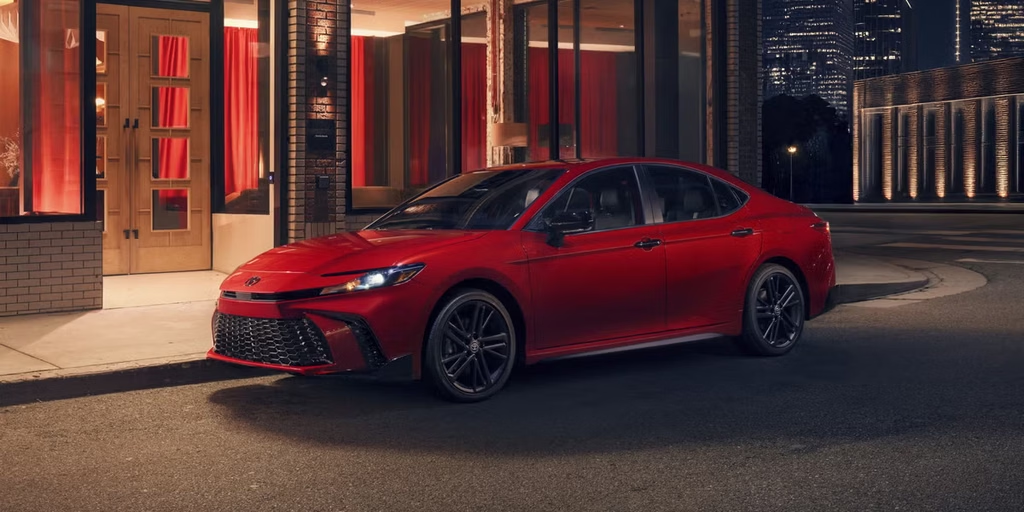
The biggest visual addition to the 2026 Camry lineup is the Nightshade Edition.
Toyota builds Nightshade on the sport-oriented SE platform.
It adds a collection of Midnight Black Metallic exterior details including:
- Front grille
- Air curtains
- Side canards
- Door handles
- Mirror caps
- Shark-fin antenna
- Rear lower sport diffuser
- Rear spoiler
- Gloss-black badging
It also receives distinctive 19-inch satin-black wheels.
The Nightshade is available in several exterior colors, including:
- Ice Cap
- Supersonic Red
- Midnight Black Metallic
Toyota also introduced the new Dark Cosmos blue exterior color for selected 2026 Camry trims including SE, XLE, and XSE.
Is the Camry Nightshade Worth It?
The Nightshade is mostly about appearance rather than additional horsepower.
It uses the same basic hybrid powertrain as the rest of the Camry range.
What customers are paying for is the blacked-out exterior treatment, 19-inch wheels, sport-oriented suspension tuning, and more aggressive appearance.
For someone already considering an SE, the price increase is relatively modest.
For someone focused purely on fuel efficiency and value, however, the LE makes much more sense.
Larger 19-inch wheels can also mean more expensive replacement tires compared with the LE’s smaller wheels.
Sport-Tuned SE, Nightshade and XSE
Toyota gives the SE, Nightshade, and XSE trims a sportier suspension setup than LE and XLE.
The sport trims use specific shock absorbers and a larger-diameter front stabilizer bar designed to improve stability and handling response.
That does not turn the Camry into a dedicated sports sedan.
But it gives drivers who dislike soft family-sedan handling an alternative within the same lineup.
Toyota also includes selectable driving modes such as:
- Eco
- Normal
- Sport
These allow drivers to adjust how the car responds depending on whether they prioritize efficiency or responsiveness.
2026 Toyota Camry Interior
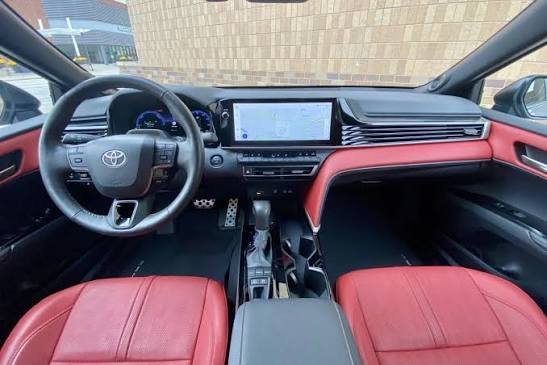
The Camry remains a five-passenger midsize sedan.
Toyota lists approximately:
42.1 inches of front legroom
38.0 inches of rear legroom
The cabin therefore provides enough room for adults in both seating rows.
This is one of the advantages of a midsize sedan over smaller compact cars.
Parents can install child seats in the rear while maintaining useful front-seat room, and adult passengers can sit comfortably during road trips.
Interior materials vary substantially by trim.
LE focuses on practicality.
SE and Nightshade receive sportier interior details.
XLE emphasizes comfort.
XSE combines premium equipment with sport styling.
Camry Cargo Space
Toyota lists approximately 15.1 cubic feet of trunk space for the Camry.
That is enough room for everyday loads such as:
- Grocery bags
- Suitcases
- Backpacks
- Golf equipment
- Baby supplies
- Work bags
- Smaller household items
The rear seats also use a split-folding design, making it possible to carry longer objects when necessary.
The Camry obviously cannot match the cargo flexibility of a RAV4 or CR-V.
Buyers regularly carrying bicycles, large dogs, furniture, or bulky outdoor equipment may still prefer a crossover.
For normal family and commuter use, however, the trunk is perfectly practical.
2026 Camry Infotainment
Toyota offers two primary touchscreen sizes.
Lower grades use an 8-inch Toyota Audio Multimedia touchscreen.
Higher trims can receive a larger 12.3-inch display.
Standard connectivity includes:
- Wireless Apple CarPlay
- Wireless Android Auto
- Qi wireless phone charging
- Bluetooth connectivity
- Multiple USB ports
Toyota provides five USB ports across the Camry lineup, including front and rear connections.
Wireless smartphone connectivity means owners do not need to connect a cable every time they get into the vehicle.
Digital Gauge Cluster
LE, SE, and Nightshade models receive a 7-inch digital gauge display.
XLE and XSE upgrade to a 12.3-inch digital gauge cluster.
The larger display can provide information such as:
- Vehicle speed
- Hybrid system activity
- Fuel economy
- Navigation information
- Driver-assistance alerts
- Trip data
Higher trims can therefore feel considerably more modern than the entry-level LE.
Head-Up Display
An available 10-inch Head-Up Display can project important information into the driver’s field of view on appropriately equipped XLE and XSE models.
Information can include speed, navigation directions, and safety alerts.
A head-up display can be useful on long trips because the driver does not need to look down at the instrument panel as frequently.
Available Panoramic Roof
XLE and XSE models can be equipped with a power tilt-and-slide panoramic roof with a retractable sunshade.
This gives higher trims a more premium interior atmosphere.
However, buyers focused on maximum value probably do not need it.
Panoramic roofs increase cost and complexity while reducing some headroom compared with a solid roof.
Premium Interior Features
Depending on trim and options, buyers can find equipment such as:
- Heated front seats
- Ventilated front seats
- Leather-trimmed steering wheel
- Power front seats
- Driver memory
- Panoramic moonroof
- JBL premium audio
- Head-Up Display
- Digital Key
- Panoramic View Monitor
The XLE and XSE are the main trims for buyers wanting these luxury-oriented features.
Toyota Safety Sense 3.0
Every 2026 Camry includes Toyota Safety Sense 3.0 as standard equipment.
The package includes technologies such as:
- Pre-Collision System with Pedestrian Detection
- Full-Speed Range Dynamic Radar Cruise Control
- Lane Departure Alert with Steering Assist
- Lane Tracing Assist
- Road Sign Assist
- Automatic High Beams
- Proactive Driving Assist
Standard Blind Spot Monitor with Rear Cross-Traffic Alert is also included across the lineup.
These technologies are designed to assist drivers, not replace them.
The driver remains responsible for controlling the vehicle and monitoring road conditions.
Pre-Collision System
Toyota’s Pre-Collision System uses camera and radar technology to help detect certain vehicles, pedestrians, cyclists, and other hazards.
The system can provide visual and audible warnings and, under certain conditions, automatically apply braking if the driver does not respond.
Automatic emergency braking is now becoming common in modern cars, but having it standard across the Camry range is still important.
Adaptive Cruise Control
Full-Speed Range Dynamic Radar Cruise Control can automatically adjust the Camry’s speed to help maintain a selected following distance from traffic ahead.
Unlike simpler cruise-control systems, it can work across a broad range of speeds.
This is particularly useful on highway road trips and in traffic where speeds change frequently.
Lane Tracing Assist
Lane Tracing Assist works with adaptive cruise control to help keep the Camry centered in a detected lane.
Toyota also includes an Emergency Driving Stop System designed to respond if the system determines the driver is unresponsive after repeated warnings.
Again, this remains an assistance feature rather than autonomous driving.
Available Traffic Jam Assist
Higher XLE and XSE trims can be equipped with an optional Premium Plus Package that adds several more advanced driver-assistance technologies.
One of the most interesting is Traffic Jam Assist.
Toyota says the system can assist with steering, braking, and acceleration in certain stop-and-go freeway conditions below approximately 25 mph when applicable requirements are satisfied.
Additional available systems include:
- Front Cross-Traffic Alert
- Lane Change Assist
- Panoramic View Monitor
- Front and Rear Parking Assist with Automatic Braking
- Driver monitoring technology
Some connected features require an active service subscription after applicable trial periods.
Camry as a Daily Commuter
Commuting is arguably where the 2026 Camry makes the most sense.
Consider what the LE offers:
- Around 50 mpg
- Five seats
- Large sedan cabin
- Hybrid powertrain
- Standard adaptive cruise control
- Standard emergency braking
- Wireless smartphone connectivity
- Available AWD
For someone driving 15,000 or 20,000 miles every year, strong fuel economy can become much more valuable than having SUV styling or a large pickup bed that is rarely used.
The Camry also has a lower roofline and center of gravity than most SUVs, which can make it feel easier and more stable to drive on highways.
Camry as a Family Car
Although crossovers dominate the American family-car market, the Camry still makes a strong argument for the traditional sedan.
It provides:
- Five-passenger seating
- 38 inches of rear legroom
- 15.1 cu. ft. trunk
- Standard safety technology
- Excellent fuel economy
- Available AWD
- Comfortable highway driving
A family that does not need the extra cargo height of an SUV may save money on both the initial vehicle price and long-term fuel costs by choosing a Camry.
Camry for Long Road Trips
The Camry’s combination of fuel efficiency and highway comfort makes it particularly suitable for road trips.
A vehicle capable of returning fuel economy in the 40-to-50-mpg range can travel significant distances between fuel stops.
Adaptive cruise control, Lane Tracing Assist, comfortable seating, smartphone connectivity, available JBL audio, and optional driver-assistance technology can also reduce some of the workload during long interstate journeys.
Unlike an electric vehicle, a regular Camry Hybrid does not require charging stops.
Drivers simply refuel with gasoline as they would with a conventional car.
2026 Toyota Camry Pros
Excellent Fuel Economy
The Camry LE is currently rated at approximately 52 mpg city and 49 mpg highway.
Few conventional midsize family cars can match that efficiency.
Hybrid Power Is Standard
Customers do not have to choose between a basic gasoline model and an expensive hybrid upgrade.
Every 2026 Camry includes Toyota’s fifth-generation hybrid system.
Available AWD on Every Trim
All five Camry trims can be ordered with electronic AWD.
This makes the Camry much more practical for buyers living in areas with difficult winter weather.
225 or 232 Horsepower
The standard hybrid system provides enough power for normal family and commuter use while maintaining excellent efficiency.
Reasonable Starting Price
Current Toyota listings place the Camry LE at around $29,600 MSRP.
Considering that hybrid technology is standard, the Camry remains relatively accessible.
Standard Safety Technology
Toyota Safety Sense 3.0 and Blind Spot Monitor provide a strong standard driver-assistance package.
New Nightshade Edition
The Nightshade provides a more aggressive appearance for buyers who find regular Camry styling too conservative.
Comfortable Passenger Space
Approximately 42.1 inches of front legroom and 38 inches in the rear make the Camry useful for adults.
Good Technology Options
Wireless Apple CarPlay and Android Auto are standard, while higher trims can receive a 12.3-inch touchscreen, digital gauge cluster, HUD, and advanced driver-assistance features.
2026 Toyota Camry Cons
No Gas-Only Version
Anyone who specifically wants a traditional non-hybrid Camry no longer has that option.
Every model uses hybrid technology.
For most buyers this is probably an advantage, but customers wanting maximum mechanical simplicity may disagree.
No Plug-in Hybrid
The Camry is a conventional self-charging hybrid.
Unlike a Toyota Prius Plug-in Hybrid or RAV4 PHEV, it cannot be plugged in and driven for dozens of miles solely using external electricity.
Less Cargo Flexibility Than an SUV
The 15.1-cu.-ft. trunk is useful, but it cannot compete with the open cargo area and taller loading space of a RAV4 or Honda CR-V.
Sport Trims Lose Some MPG
Large wheels and performance-oriented equipment reduce fuel economy.
The XSE AWD, for example, is currently listed at approximately 43 mpg city and highway, compared with 52/49 for the FWD LE.
Higher Trims Can Approach $40,000
The XSE AWD starts around $37,525 before destination, packages, taxes, and dealer fees.
Adding premium packages can push pricing noticeably higher.
Not a True Sports Sedan
The SE, Nightshade, and XSE provide sportier suspension and styling, but buyers expecting performance comparable with dedicated sport sedans may be disappointed.
The Camry is still primarily designed around efficiency, comfort, and everyday usability.
Who Should Consider the 2026 Toyota Camry?
The Camry is particularly suitable for:
- Daily commuters
- Families needing five seats
- High-mileage drivers
- Buyers prioritizing fuel economy
- Drivers wanting hybrid technology without plugging in
- People who prefer sedans over SUVs
- Buyers living in snowy climates who want AWD
- Rideshare drivers
- Highway commuters
- Buyers looking for standard safety technology
- Drivers who want relatively low fuel consumption without purchasing an EV
For value-focused buyers, the LE is difficult to ignore.
For someone wanting a sportier look, the SE or Nightshade makes sense.
Luxury-oriented customers should compare XLE and XSE.
2026 Toyota Camry vs. Honda Accord
The Honda Accord remains one of the Camry’s traditional rivals.
Both vehicles provide five-passenger seating, spacious interiors, efficient powertrains, modern safety equipment, and comfortable highway manners.
One of the Camry’s biggest advantages is available AWD.
The Camry also makes hybrid technology standard across its entire lineup.
The Accord may appeal more to buyers who prefer Honda’s interior layout, driving feel, or particular trim structure.
Choosing between them should involve an actual test drive rather than simply comparing specifications.
Seat comfort, steering feel, visibility, infotainment controls, and ride quality are subjective and can matter significantly during everyday ownership.
Camry vs. Compact SUVs
Many people automatically buy an SUV today even when they do not actually need one.
Compared with a compact crossover, a Camry generally offers:
- Better fuel economy
- Lower seating position
- More car-like handling
- Potentially lower purchase price
- Excellent highway stability
A compact SUV offers:
- Taller cargo area
- Higher seating position
- Easier loading for bulky items
- More ground clearance
- Greater cargo flexibility
If you regularly carry large objects, dogs, bikes, or outdoor equipment, a RAV4 may make more sense.
If most of your driving involves commuting with one to four people and normal luggage, the Camry can be considerably more efficient.
Is the 2026 Toyota Camry Worth Buying?
For American buyers who still appreciate sedans, the 2026 Toyota Camry is one of the strongest all-around choices on the market.
Its main advantage is how little compromise the hybrid system requires.
Buyers receive up to roughly 50 mpg without needing home charging, an entirely electric vehicle, or a complicated daily routine.
The LE provides especially strong value with a starting MSRP around $29,600 and fuel-economy ratings of approximately 52 mpg city and 49 mpg highway.
Drivers wanting additional traction can add AWD to any trim.
Toyota’s AWD hybrid system raises output from 225 to 232 horsepower while retaining excellent fuel economy.
For 2026, the Nightshade Edition also gives buyers another styling choice, adding 19-inch black wheels and extensive Midnight Black Metallic exterior trim.
The Camry does have limitations.
It cannot match an SUV’s cargo versatility.
There is no conventional gasoline version or plug-in hybrid.
And premium trims become noticeably more expensive.
But for commuting, family transportation, road trips, rideshare work, and general everyday driving, the Camry’s combination of efficiency, price, AWD availability, technology, passenger room, and standard safety equipment is extremely difficult to ignore.
Frequently Asked Questions
How Much Does the 2026 Toyota Camry Cost?
Toyota’s current regional U.S. listings show the 2026 Camry LE starting around $29,600 MSRP before destination and additional charges.
Is the 2026 Toyota Camry Hybrid?
Yes.
Every 2026 Toyota Camry sold in the U.S. uses Toyota’s fifth-generation hybrid system.
How Much Horsepower Does the 2026 Camry Have?
Front-wheel-drive models produce 225 net combined horsepower.
AWD models produce 232 net combined horsepower.
What MPG Does the 2026 Toyota Camry Get?
The most efficient LE FWD is currently rated at approximately 52 mpg city and 49 mpg highway.
Fuel economy varies by trim and drivetrain.
Does the 2026 Toyota Camry Have AWD?
Yes.
Electronic On-Demand AWD is available on LE, SE, Nightshade, XLE, and XSE trims.
Does the Camry Need to Be Plugged In?
No.
The regular Camry Hybrid charges its battery automatically through the gasoline engine and regenerative braking.
There is no charging cable required for normal ownership.
What Is the 2026 Camry Nightshade?
Nightshade is a new 2026 appearance-focused Camry based on the SE.
It adds Midnight Black Metallic exterior details, gloss-black badging, and 19-inch satin-black wheels.
How Many People Does the Camry Seat?
The Camry seats five passengers.
How Much Trunk Space Does the Camry Have?
Toyota lists approximately 15.1 cubic feet of cargo capacity.
Does the 2026 Camry Have Apple CarPlay?
Yes.
Wireless Apple CarPlay and Android Auto compatibility are standard.
Does the Camry Have Adaptive Cruise Control?
Yes.
Full-Speed Range Dynamic Radar Cruise Control is included as part of Toyota Safety Sense 3.0.
Which Camry Gets the Best MPG?
The Camry LE FWD provides the highest official fuel-economy figures in the lineup.
Which Camry Is Best for Winter Driving?
Any AWD version can provide additional winter traction.
An LE AWD is particularly attractive because it combines AWD with excellent fuel economy.
Which Camry Is Best for Value?
For buyers focused on operating costs and practical transportation, the LE offers one of the strongest combinations of price and efficiency.
Which Camry Is the Sportiest?
XSE provides the most premium sport-oriented combination, while the new Nightshade offers distinctive black styling for less money.
Final Verdict
The 2026 Toyota Camry proves that the traditional American family sedan still has plenty of life left.
Toyota has made hybrid technology standard rather than treating it as an expensive specialty option.
The result is a midsize sedan capable of returning around 50 mpg while still offering five usable seats, a practical trunk, available AWD, strong standard safety technology, and enough power for everyday driving.
For most buyers, the LE provides the strongest value.
Someone wanting more visual personality should consider the SE or new Nightshade.
The XLE is aimed at comfort-focused buyers, while XSE combines premium features with sportier styling and suspension tuning.
The biggest reason to consider a Camry over a crossover is efficiency.
If you do not regularly need SUV cargo space or ground clearance, buying a taller and heavier vehicle simply because SUVs are fashionable may not make much sense.
The Camry offers a more efficient alternative without giving up the comfort, technology, safety equipment, and passenger room that most people actually use every day.
Before purchasing, compare actual dealer pricing, insurance rates, financing offers, trim equipment, tire replacement costs, and whether AWD genuinely makes sense for your location.
Disclaimer: Vehicle prices, fuel-economy estimates, specifications, equipment, safety features, and availability can vary by trim, configuration, region, and model-year updates. Always verify current information with Toyota and the specific vehicle documentation before purchasing.